



Updated November 19, 2024
Learn Japanese Faster: 7 Underrated yet Effective Tools
The first thing to know about learning a new language is that there’s no single best way to do it.
Textbooks, flashcards, and classroom lectures certainly have their place. But you don’t have to limit yourself to traditional learning methods when tackling a language as complex as Japanese. Many learners find that self-study can be highly effective, but even that approach can benefit from some fresh perspectives.
So today, we'll introduce some underrated tools for learning Japanese that can help you engage with the language and accelerate your learning process.
Let's take a look.
In this article: 📝
1. NINJAL-LWP
NINJAL-LWP (NINJAL- LagoWordProfiler) is primarily for advanced users, as it's all in Japanese. It's a superb tool for searching through the Tsukabe Web Corpus, which includes over 1.1 billion words, all retrieved from Japanese resources online.
This tool is a product of the National Institute for Japanese Language and Linguistics (NINJAL)’s Lago Institute of Language, hence the name.
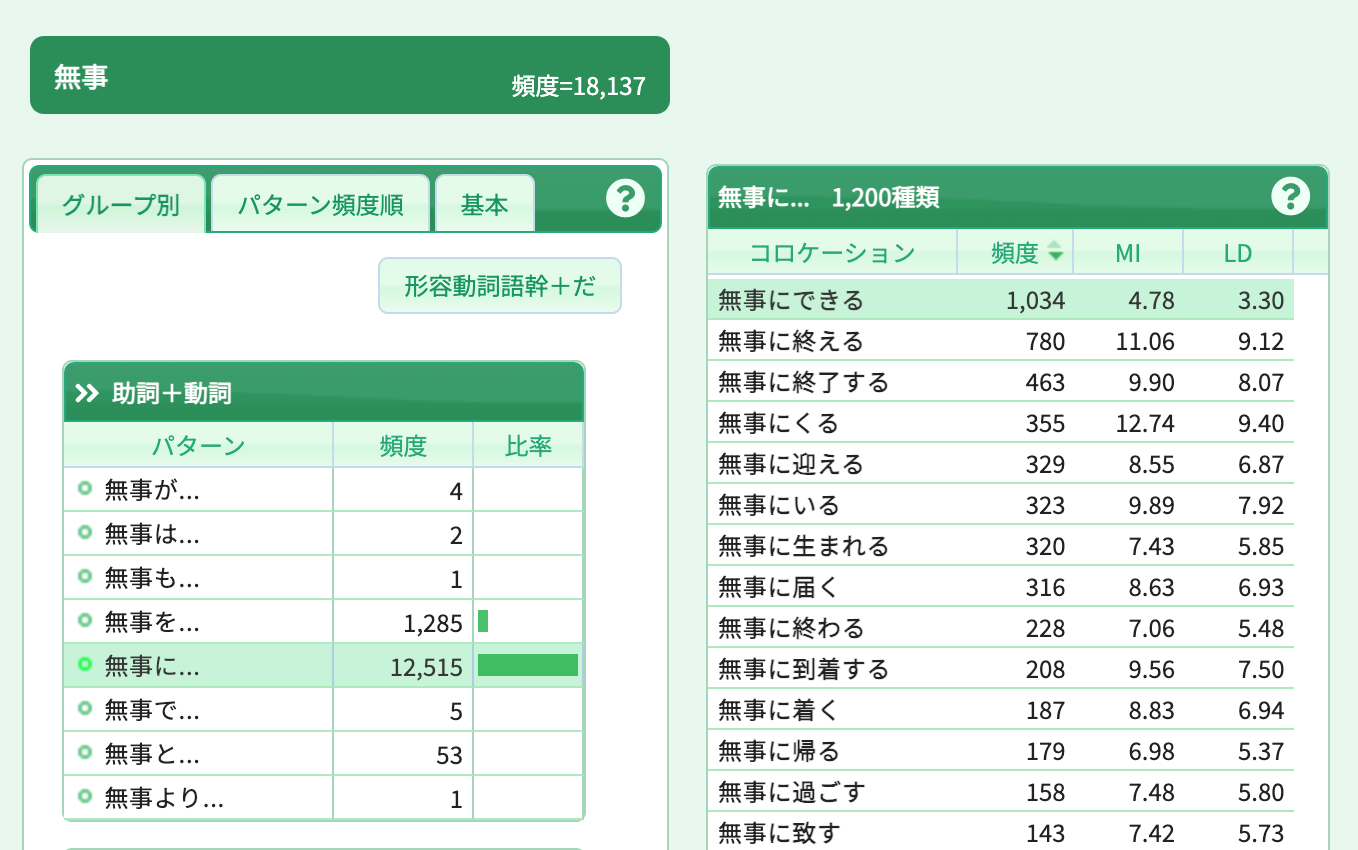
NINJAL-LWP is a highly underrated tool on our list simply because it provides you with endless references and context whenever you want to find out what a word means. Simply type in your search word, and you’ll instantly see all of the ways the word is used in sentences across the web.
Thanks to context cues, understanding the true meaning of words can be even easier than looking up a definition, as it promotes an organic way to learn the Japanese language.
Another great thing about the NINJAL-LWP is that it uses lexical profiling to aid language learning. It doesn’t just show how a word is used but also its co-occurrence relation with other words and the grammatical behavior of nouns and how they’re used, making it an invaluable tool.
For example, have you ever learned a new word, but then struggled to actually use it in sentences? NINJAL-LWP lets you view the most commonly used particles, verbs and forms for an enormous amount of words. It's an amazing tool for checking how a word is actually used, with lots of usage examples from native Japanese sources.
NINJAL-LWP is one of the best ways to quickly understand how Japanese words are used.

2. Google Images
The good old Google Images can be your best friend when you don’t know what a word means.
Yes, a dictionary does the same thing, but an image often conveys meaning more quickly and clearly, allowing you to grasp concepts instantly.
This method is particularly useful when you’re confusing two words or if there’s a slight nuance between them. For instance, 石 and 岩 both mean rock, but if you type it in Google Images, you’ll clearly understand what the distinction between the two words is right away.
So, the next time you don’t know what a Japanese word means, do a simple Google image search, and you’ll see how simple yet effective it is.
3. Apple Dictionary
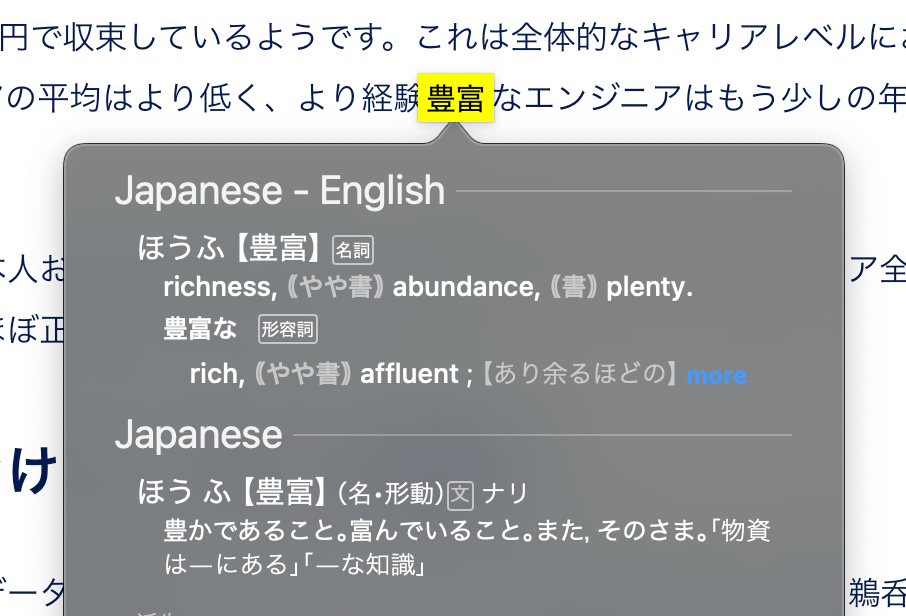
If you’re using a Mac or an iPhone, you’ll find Apple’s on-board dictionary very useful. It has tons of great dictionaries built-in, and you can simply access it with a right-click or by using the “look-up” shortcut on your Mac.
Using Apple Dictionary on a Mac is pretty easy: the pre-installed app allows you to add your desired dictionaries and instantly find out the meaning of every word on your screen.
We recommend using the “Wisdom” dictionary and pairing it with the "デジタル大辞泉" or a similar choice. This makes for a much higher-quality dictionary, better than the ones you’ll find online, like Jisho.org, which tends to use lower-quality free or open-source data.
As for the iOS, while there’s no dedicated Dictionary app on iPhones and iPads, you can still long press any word and use the “look up” command.
You also have access to all of the dictionaries you’ll find on the Mac, they’re just managed differently. Just head over to your settings app and navigate to “General”, and you’ll find the dictionary settings with a simple scroll.
4. ChatGPT
The question “How can I learn Japanese language by myself?” isn’t too hard to answer when there’s plenty of large language models around these days. One of the best and most accessible of these is ChatGPT.
Since you can ask deliberate questions, ChatGPT can simply act as your “on-call language teacher”, but its functionality offers much more than that.
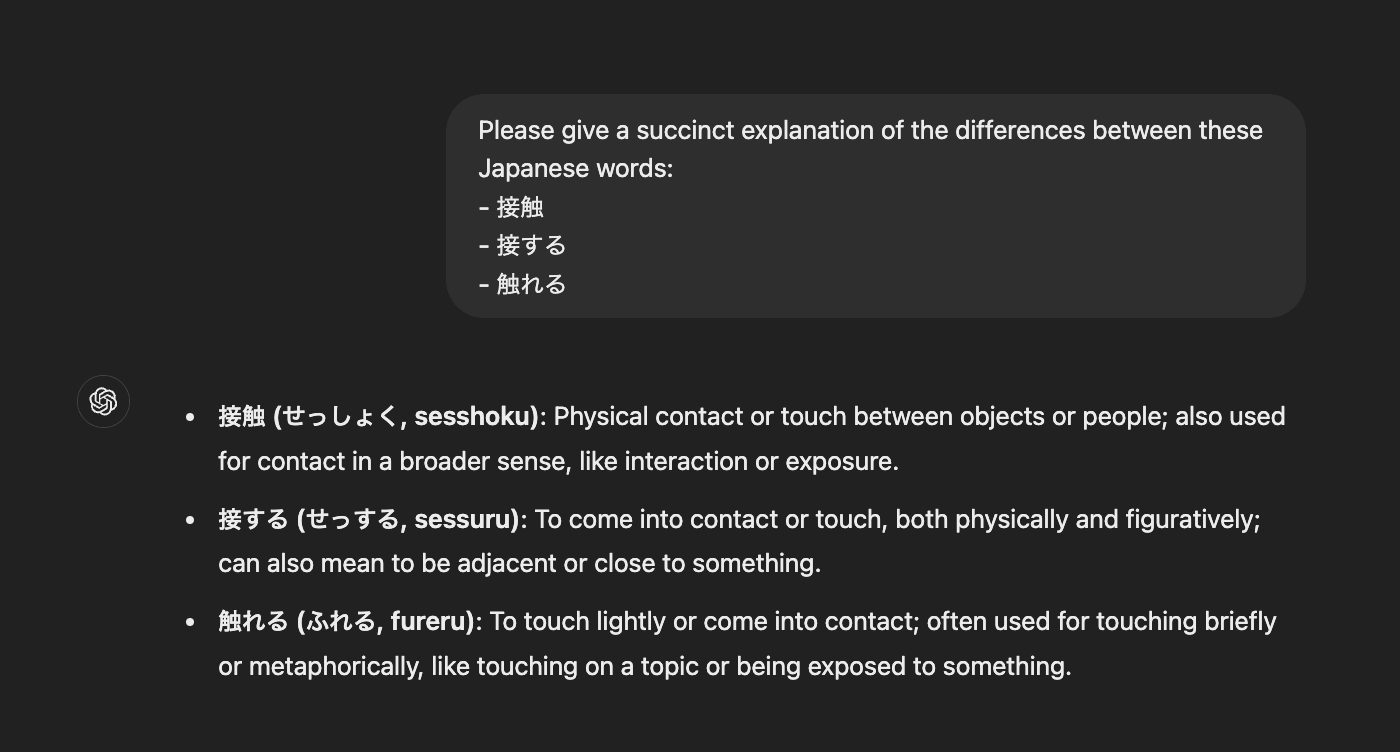
For example, you can ask questions such as “How is X different than Y?” to quickly find out the difference between two similar words. You can even ask GPT to explain a grammatical concept you might have trouble figuring out.
ChatGPT can also help you with long translations, and it can even summarize long, complex Japanese texts into simpler terms or fewer words.
Another use case of ChatGPT is generating texts. Using simple prompts, you can easily create e-mails and messages in Japanese.
However, while having ChatGPT write for you can be useful sometimes, if you really want to learn Japanese, writing a text yourself and asking GPT to check, edit, and correct your original text can help you improve even faster.
You can also try simply chatting with ChatGPT in Japanese! It understands Japanese text well, and can even provide tips and improvements in real-time if you ask it to.
5. Shadowing Method
This one isn’t so much of a tangible tool but a method, and a very useful one at that. If you’ve ever wondered, “Can I learn Japanese by listening?”, here’s your answer.
Shadowing is a term that means repeating someone’s words or following their actions. This technique is often utilized in a wide variety of fields when teaching and learning, and you can very well use it for learning Japanese, too.
To start practicing this method, you need source material like a Japanese podcast, a YouTube video, or an audiobook. As you say things out loud, you’ll learn how to say certain words, see where you’re struggling with pronunciation, and, more importantly, get used to the way sentences are formed in Japan.
Since you’re actively listening throughout the whole exercise, this is also a great way to improve your listening skills and learn pitch, accent, and intonation.
Bonus points if you record yourself as you shadow Japanese sources, as you can always go back and see how you sound. Plus, this will also help you hear how much you’re improving.
Simply compare your recording to the source to see if there are any differences, and keep at it. You’ll be surprised by how quickly you begin to understand the natural flow of spoken Japanese.

Great Resources For Shadowing
While our podcast recommendations are useful for shadowing, it’s beneficial to have a variety of audio resources.
Our first recommendation is a two-part YouTube series on the Japanese pitch accent. These videos are great for correcting your pitch, and both the first and second parts are around 20 minutes long. The YouTube channel has some other useful videos you can shadow as well.
Another great resource for shadowing audio comes from Osho Taigu, a renowned life coach. While this isn’t necessarily teaching material, it’s great Japanese practice because Taigu speaks very clearly and slowly. You can pick any of his material, but this video titled “Four ways to happiness” is a great place to start.
However, you might find that listening to Japanese from male and female perspectives might sound a little different. Things like certain vocab and expressions can differ slightly, especially when spoken casually, so female-identifying readers may find it useful to practice speaking based off female voices. For this, I recommend PIVOT.
PIVOT is a great YouTube channel that delivers free daily video content focused on business and learning, and features both male and female speakers in their videos. Just scroll through their list of content and pick a topic that interests you. The speakers may talk a bit faster here, but this is conversational speed, which can also help you understand things you hear in daily life more easily.
Finally, Japanese audiobooks are also great for shadowing. If you’re shadowing anime, choose a genre or a character you can relate to in daily life, which our article on anime can help with.
6. JPDB.io
Unlike online dictionaries like Jisho.org or Tangorin, Jpdb.io is both a dictionary and a comprehensive learning system.
We have already introduced the Apple Dictionary as a good alternative to open-source, online options, but Jpdb.io takes things a few steps further. Here, you don’t just have access to words and their meanings but also have thousands of themed “decks.”
The decks essentially help you learn Japanese in a focused manner. For instance, if your goal is to start understanding your favorite anime as soon as possible, there are decks tailored for this purpose.
Jpdb.io is also able to extract vocabulary from text. This way, any body of text you copy into the tool turns into Japanese learning material. Jpdb achieves this by automatically extracting all of the words from the text and explaining them to you in order.
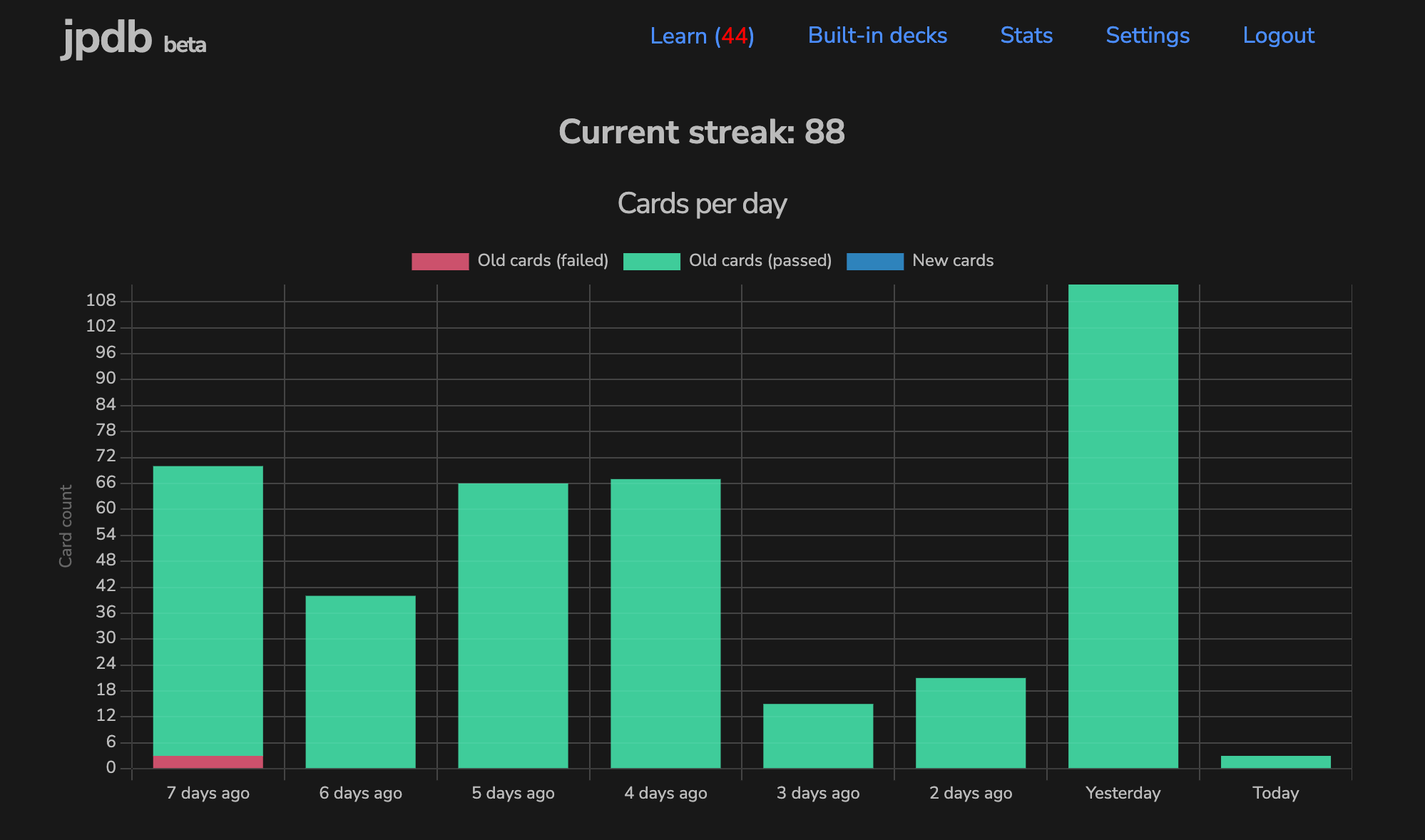
What’s more, the tool loads quite fast and is so smart that it can even recommend which show to watch next based on your learned vocabulary. This is all possible thanks to its extensive database and the spaced repetition algorithm.
With over 130 million Japanese sentences, the tool always tracks your progress. This is how it’s able to show example sentences with only the words you’ve previously learned so that you get all the context you need.
Jpdb.io also includes audio clips. This means you don’t just learn the words and the kanji but also how words and sentences are pronounced.
With additional information on how frequently the word is used and the correct pitch accent, you’ll have a much better understanding of Japanese vocabulary.
7. Yomitan
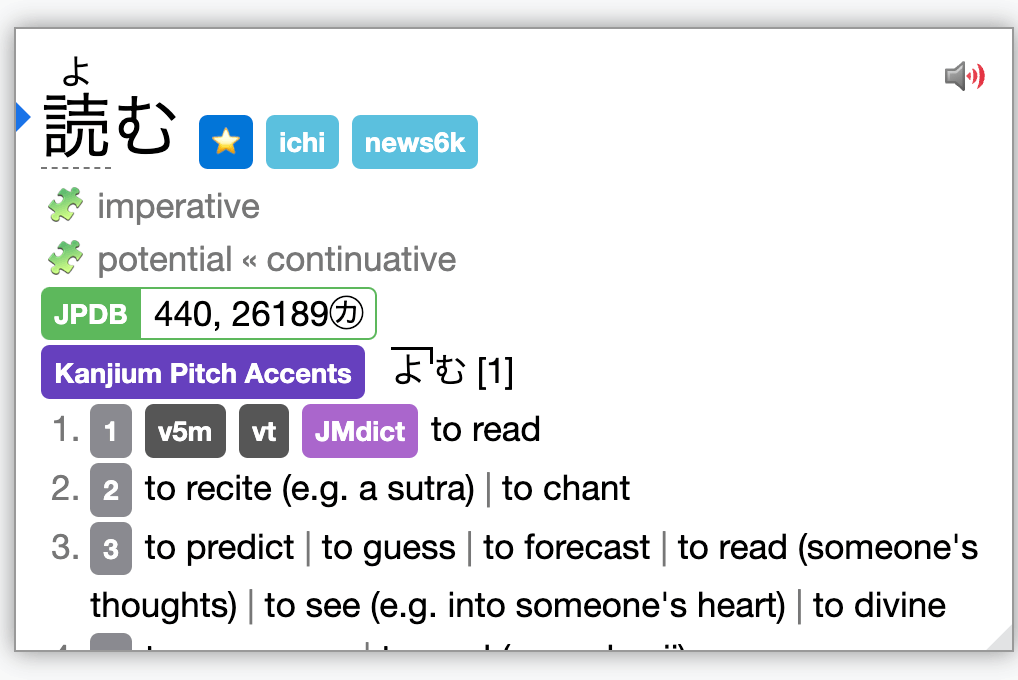
This final entry on our list certainly doesn’t make it the least useful, as Yomitan is an excellent browser extension for Japanese learners.
This Chrome extension, which is a great alternative to the Apple Dictionary, helps you quickly look up the words you see on your browser without switching tabs or windows.
You’ll have to use the Chrome browser for this, but this shouldn’t be a big deal, considering the browser’s widespread use. If you’re worried about setting the extension up, you can follow this setup guide, which even helps you set up your dictionaries.
Yomitan includes a great collection of dictionaries, which are the most common and useful ones available.
Finally, if you’re using Anki, you’ll be glad to know that Yomitan offers seamless integration to create cards and decks. Anki is a popular free tool for creating flashcards that we’ve featured in our other Japanese learning tools guide, so check it out for even more tools and resources.

Other Resources: How Can I Learn Japanese Language By Myself?
If you’re looking for more resources on learning Japanese, we have other useful guides that can help you on your language learning journey.
To name a few:
If you’re still a beginner and want to apply for jobs that don’t require Japanese, you can check out the available opportunities right away.


Japan Dev Team
This post was written by our Japan Dev editorial team.
- Senior Backend Engineer (Go), Communication Platform Department, ...
- Money Forward
- Tokyo
- ¥7M ~ ¥11M
- Logistics Robot Hardware Engineer (Mass Production Design)
- Telexistence
- Tokyo
- ¥6M ~ ¥8M
- 【exaBase Studio】Senior Platform Engineer
- ExaWizards
- Tokyo
- ¥8M ~ ¥13M
- Mobile Engineer (Sales AI Agent)
- ExaWizards
- Tokyo
- ¥6.48M ~ ¥10.08M
- Product Designer (Gen AI x HR Tech Solutions)
- ExaWizards
- Tokyo
- ¥5M ~ ¥9.6M



Latest Tech Jobs 🇯🇵
Explore the top developer jobs in Japan for foreigners
- Senior Backend Engineer (Go), Communication Platform Department, ...
- Money Forward
- Tokyo
- ¥7M ~ ¥11M
- Logistics Robot Hardware Engineer (Mass Production Design)
- Telexistence
- Tokyo
- ¥6M ~ ¥8M
- Mobile Engineer (Sales AI Agent)
- ExaWizards
- Tokyo
- ¥6.48M ~ ¥10.08M
- Product Designer (Gen AI x HR Tech Solutions)
- ExaWizards
- Tokyo
- ¥5M ~ ¥9.6M
- 【exaBase Studio】Senior Platform Engineer
- ExaWizards
- Tokyo
- ¥8M ~ ¥13M
- Senior Fullstack Engineer (Generative AI Product team)
- ExaWizards
- Tokyo
- ¥8M ~ ¥13M
- Software Engineer (Product)
- Remody
- Tokyo
- ¥10M ~ ¥15M
- Senior Fullstack Engineer (Tokyo)
- Mico
- Tokyo
- ¥7M ~ ¥9M
- QA Manager (Osaka)
- Mico
- Osaka
- ¥8M ~ ¥12M
- QA Manager (Tokyo)
- Mico
- Tokyo
- ¥8M ~ ¥12M


Get Job Alerts
Sign up for our newsletter to get hand-picked tech jobs in Japan – straight to your inbox.

© 2026 Japan Dev. All rights reserved.
Proudly built in Tokyo.


Curated with 💙 in Tokyo by Eric Turner
All our data is gathered from publicly available sources or contributed by users