



Updated June 19, 2025
Moving to Japan on the J-Find Visa: A Complete Guide for 2025
The J-Find visa is an intriguing new option for those wishing to move to Japan, allowing graduates from top global universities to engage in job-seeking or business startup activities for up to two years.
While I’d always been interested in moving to Japan, most of the existing methods of getting into the country had drawbacks that didn’t appeal to me.
With J-Find, I’ve been able to take my time job-hunting while in the country, opening up countless more opportunities and allowing me to have the flexibility to work part-time and self-study Japanese.
In this article, I’ll explain everything you might want to know about the J-Find visa, from the basic requirements and application process to my own experience.
In this article: 📝
Background & Eligibility
The J-Find visa was first introduced in 2023 as part of the Japanese government's efforts to attract more foreign talent to the country. J-Find targets recent graduates from top universities who wish to job hunt or start a business in Japan.
Officially, it is called “Designated Activities (Future creation individual)”, and is typically granted for 1 year, but can also be issued for 6 months or other terms up to 12 months as determined by the immigration office.
It can then be renewed for two additional six-month terms, allowing for a total possible stay of up to two years.
Holders of the visa may also work part-time or freelance to support themselves while they job hunt or prepare their business. There is no limit on the type of work, excluding jobs at bars, nightclubs, or adult entertainment establishments.
To qualify for this visa, candidates must meet all of the following requirements per the Ministry of Foreign Affairs’ website:
Have graduated with a bachelor’s degree, master’s degree, or PhD from any one of the top 100 universities in the world.
Been awarded the degree within the last 5 years before the date of application.
Possesses enough personal savings to support themselves in Japan (at least 200,000 yen; roughly $1,400).
The list of universities is provided on the MOFA website and is updated yearly based on rankings from QS World University Rankings, Times Higher Education, and Shanghai Ranking. Your university must rank within the top 100 on at least two out of those three.
Also note that it’s only the university’s current ranking that matters. Even if your university wasn’t in the top 100 when you attended, if it is now, you qualify, so long as your graduation was within the last five years.
Additionally, consider that while 200,000 yen is the requirement, it’s ultimately a paltry amount once you factor in moving costs and ongoing living expenses. You should ideally have far more savings or some source of income to keep you afloat.
Finally, it’s worth pointing out that the J-Find visa holder may bring their spouse and/or child to Japan as a dependent, officially referred to by the catchy title, “Dependent spouse or child of future creation individual.”
Who is the Best Candidate for J-Find?

The main advantage of J-Find over other options is that it gets you into the country without needing to enroll in school or find a job in advance, the former of which is expensive and the latter of which can be difficult from overseas, particularly if you’re looking in fields outside of English teaching.
It’s also open to all, regardless of nationality or age, so long as the applicant is over 18. This is good news for those (notably Americans or people over age 30) who do not qualify for a working holiday visa.
If you intend to start a business, the advantage of being physically present in the country you plan to operate in is even more apparent.
As many companies are unwilling or unable to hire candidates from abroad, having boots on the ground in Japan opens up many more employment opportunities. It also means you can take your time job searching or setting up your business.
And though the main point of this visa is job-seeking, as anyone who’s ever been unemployed can tell you, you’ll have a lot of free time. You could certainly use that time to enjoy Japan, be it traveling around the country or studying the language.
That being said, this visa is certainly not for everyone. Even if you meet the basic requirements, there’s no guarantee you’ll find work or that your business will succeed. It’s thus vital to have a backup plan, and you’ll need to submit an outline of intended activities as part of your application anyway.
The ideal candidate is highly motivated, independent, and willing to embrace risk. As opposed to attending a school or enrolling in a company from the outset, there’s no structure to fall back on should something go wrong. Unless you’re lucky enough to have family or friends in Japan already, you’re essentially on your own.
For those with advanced Japanese language skills, this might be one of the best ways to come to Japan, provided you’re able to support yourself while you job search.
Language skills are not a requirement for this visa, though, so even those who can’t speak Japanese could be a good fit depending on the job/business they intend to engage in.
Those with freelance or remote jobs would also be well-suited to this visa, as you can rely less on savings. However, the end goal is to start a business or find a job in Japan, so you can’t use a remote job abroad to get a working visa later on.
If your only desire is to live in Japan short-term while working remotely, the recently launched digital nomad visa might be a better fit, though that also comes with its share of drawbacks.
Required Documents
The required documents for the J-Find visa are as follows:
Application form (from the MOFA website)
A photograph
A copy of your diploma
A copy of your passport
Completed CV form (from the MOFA website)
Description of Intended Activities (from the MOFA website)
Bank Balance Certificate showing the minimum required funds
Signed pledge to join Japan’s National Health Insurance (from the MOFA website)
Although most of the above are self-explanatory, I would like to take a moment to go into detail about the Description of Intended Activities, as this seems to be the most vague. Especially if you’re job searching, it may not be obvious what to write other than “looking for jobs.”
In my case, I talked about the types of work I’d like to pursue, my previous experience, and plans to study Japanese and pass the JLPT. I also mentioned some connections I already had in Japan who might help me find work, as well as specific job boards I intended to use.
If you’re planning on starting a business, you likely already have a business plan, in which case you could simply use that as a basis for your intended activities.
And though I can’t say for sure, it certainly wouldn’t hurt to include a part about why you want to come to Japan specifically. Try to make a connection between your business idea or future career goals and your interest in Japan.
How to Apply
The application process for J-Find can be tricky, as it depends on whether you need what is known as a Certificate of Eligibility (COE), a document used for many types of visa applications in Japan. It is proof that an entity, such as a company, school, or individual, is sponsoring you to come to Japan for the purpose stated by your visa.
The COE is then submitted to the immigration office or the local embassy in your country and used to apply for the visa proper. As the COE represents an entity in Japan vouching for you, it reduces processing time and increases the likelihood of your visa being approved.
As J-Find applicants don't yet have a job and aren't attending school, they can apply in one of two ways:
Go to Japan and apply for the COE directly at an immigration office.
Apply at a Japanese embassy in their home country without a COE.
While option 2 may immediately seem more appealing, depending on your particular embassy, you may not be able to apply for the visa without a COE. Checking with your local embassy is thus essential. As I lived in Korea, they would only accept visa applicants with a COE, so I was out of luck.
That leaves going to Japan and applying for the COE at the immigration office. In this case, you have two choices:
Enter Japan on a tourist visa and apply for the COE, stay in the country until it’s approved (usually takes about a month but can take up to three), and then convert your tourist visa to the J-Find visa while in the country.
Enter Japan on a tourist visa, apply for the COE, then leave Japan and wait for the COE to be approved. You then take the COE to apply for the visa at your local embassy and re-enter Japan with the J-Find visa.
In either case, you will need a local address to receive the COE (either your own or that of a contact living in Japan), as immigration will not mail it to you overseas.
My Application Story
This brings us to what I ended up doing: hiring an immigration lawyer based in Japan. While it was an additional cost, I don’t regret my decision as they were able to guide me through the entire process and made the application on my behalf.
This meant I never needed to go to the immigration office, and that I had someone in Japan to send me my COE after it was processed.
However, in Japan, a lawyer can only represent you while you are physically inside the country. This means that even if they apply for the COE on your behalf, you must still be in Japan at the time of application. Immigration requires your passport’s stamp page to verify this fact, so there’s no getting around it.
Without a lawyer, you could still apply at the immigration office yourself, but as mentioned above, you must have an address in Japan where you (or a contact) can receive your COE in the mail.
After gathering the necessary documents, I entered Japan for a short holiday, at which point my lawyer submitted the COE application on my behalf. After returning to Korea, I waited nervously, and then just a little over a month later, I received the good news: my COE had been approved!
That left the final hurdle: applying for the visa at the embassy. At this stage, the process will depend entirely on your country of residence, so you’ll need to check with your local embassy.
As I lived in Korea, the embassy there did not accept in-person applications. Instead, everything had to be submitted via one of a handful of embassy-approved travel agents.
In the end, this turned out to be the simplest step of the entire process. The agent submitted my COE along with a few other documents (application form, photo, passport, and residence card), and after a week, I received my passport back with my brand new visa inside!
After your visa is approved, you must enter Japan within three months of the issue date listed on your COE (not the issue date listed on your visa, as confusing as this may seem). So if your COE is issued on June 5th, you must go to the embassy, submit your COE, get your visa issued (usually takes about a week), and enter Japan by September 5th.
Failing to do so will mean the cancellation of your visa, and you will be unable to enter Japan.
Upon arrival, you submit your passport with the visa inside to the immigration official, who will present you with your newly printed Residence Card. Welcome to Japan!
Getting Settled: Banking & Housing

While the J-Find visa provides a lot of freedom, it also comes with its share of drawbacks. One of the biggest is that since you won’t have a job in Japan, your banking and housing options will be limited.
Regarding banking, my only option was Japan Post Bank (run by the Japanese post office). They are one of the few institutions that allow new arrivals to the country to open a bank account without a job.
Though JP Bank is fine to start with as a place to store your money and receive paychecks from Japanese employers, its functions are quite limited compared to other banks.
The biggest issue is that you won’t be able to make bank transfers or apply for a Visa or Mastercard-branded debit card until you’ve been in Japan for six months.
The “cash card” they give you can be used at select retailers, but it essentially only allows you to deposit and withdraw cash and cannot be used for online shopping.
As a result, I ended up using my foreign debit and credit cards almost exclusively, withdrawing cash from 7/11 ATMs as needed. Though this does work, it’s far from ideal, and means I still cannot make certain purchases or use apps that require a Japanese credit card.
Thankfully, my bank back home doesn’t incur foreign transaction fees, and due to the favorable exchange rate, my money goes further. But for those thinking of coming to Japan on the J-Find visa, be sure to check with your bank regarding foreign transactions first.
That brings us to housing. Finding a place to live in Japan as a foreigner is tough even under the most ideal conditions, as many landlords simply refuse to rent to non-Japanese. Without a job, your options grow even slimmer.
For most people, the best choice will be a sharehouse, as they are foreigner-friendly and most will not require proof of employment. They can also be cheaper than renting an apartment, and come with the added benefit of potentially making some friends with your roommates.
If you don’t want to live in a sharehouse, another idea to consider is what are known as “monthly mansions.” Despite the fancy name, these are just regular apartment rooms, but instead of the typical years-long contract, they can be reserved for a length of your choosing.
Though this is a slightly pricer option, these rooms are pre-furnished and include many basic appliances. This is good, as apartments in Japan generally come completely empty. More importantly, since these are short-term rentals, most do not require proof of employment.
Some popular options for finding a sharehouse are Oakhouse, Tokyo Sharehouse, and Borderless House. For monthly apartments, you can check out our complete guide on them here!
In either case, I’d strongly recommend getting your housing sorted before you arrive. Many sharehouses or rental agencies will be able to assist you remotely. You can sign the contract in advance, and your housing will be ready when you arrive.
Life in Japan on the J-Find Visa
After dealing with the absolute essentials, it was time to get down to the business of job-hunting. My initial goal was to start with a part-time job before eventually finding something full-time, as it would allow me more flexibility to study Japanese and generally see if I liked working in Japan.
While I did get a lot of interest from employers, I found that the novelty of the visa was sometimes a burden, especially when applying for part-time or contract work.
For instance, I received many confused inquiries as to whether I was even allowed to do part-time work (despite multiple calls to immigration confirming that, yes, I was allowed to). In some cases, I was flatly rejected simply because of my visa type.
Part of the confusion comes down to this piece of paper, which is stapled into your passport and explains the scope of activities allowed on your visa.
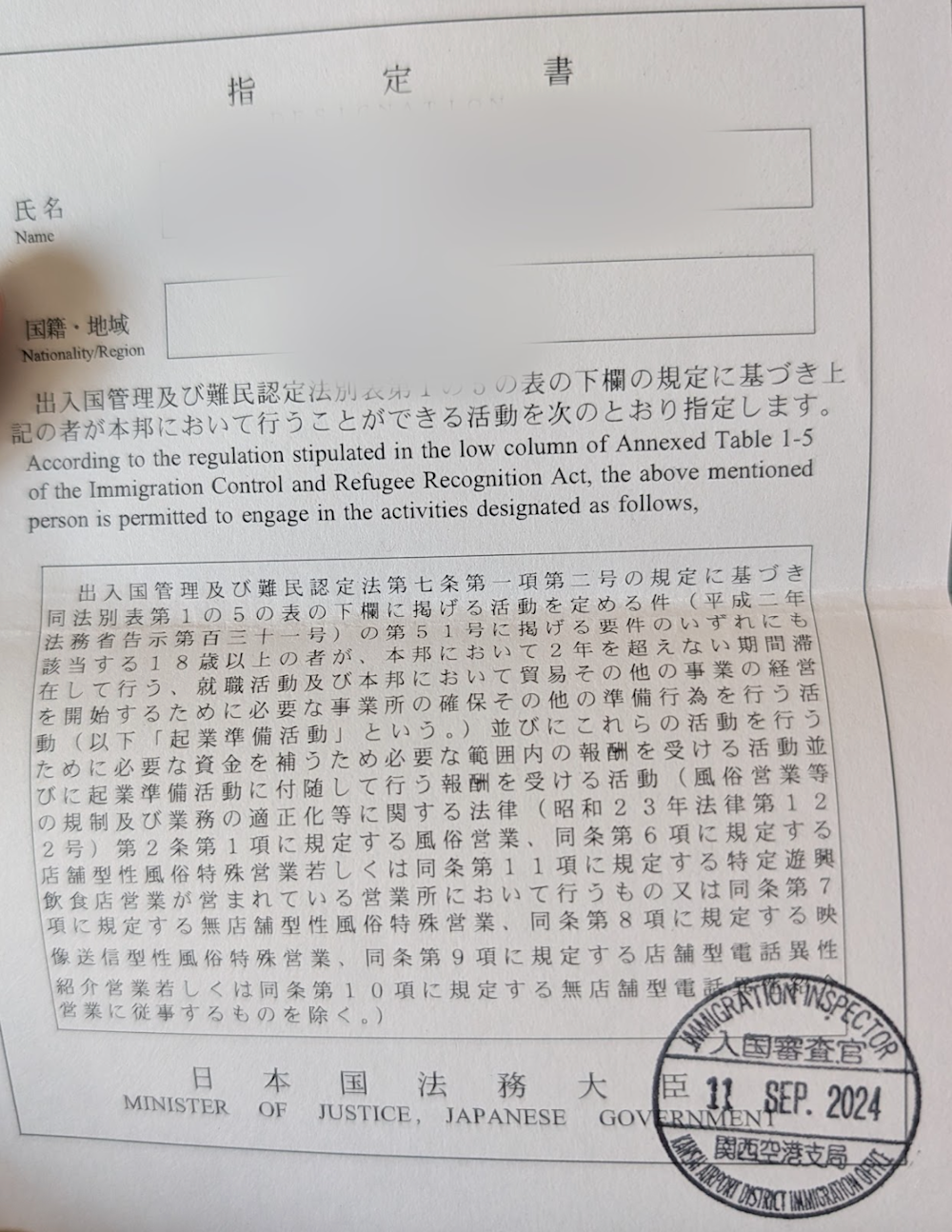
Roughly translated, it means:
Based on the provisions of Article 7, Paragraph 1, Item 2 of the Immigration Control and Refugee Recognition Act, regarding activities listed in the lower column of Table 5 of Attached Table I of the same Act, and in accordance with Item 51 of Ministry of Justice Notification No. 131 of Heisei 2 (1990), a person aged 18 or older who meets all the listed requirements, and who intends to stay in Japan for a period not exceeding two years, may engage in job-hunting activities and preparatory activities necessary for commencing the management of trade or other businesses in Japan, such as securing business premises (hereinafter referred to as "startup preparation activities"). This also includes activities where one receives remuneration to the extent necessary to supplement the funds required for these activities, and activities where one receives remuneration incidental to startup preparation activities.
(Excluding those engaged in businesses operated at establishments defined as "adult entertainment businesses" under Article 2, Paragraph 1 of the Act on Control and Improvement of Amusement Businesses, etc. (Act No. 122 of 1948), "store-based sexual entertainment special businesses" under Article 2, Paragraph 6 of the same Act, or "specified amusement and eating/drinking establishments" under Article 2, Paragraph 11 of the same Act, or "non-store-based sexual entertainment special businesses" under Article 2, Paragraph 7 of the same Act, "video transmission type sexual entertainment special businesses" under Article 2, Paragraph 8 of the same Act, "store-based telephone dating services" under Article 2, Paragraph 9 of the same Act, or "non-store-based telephone dating services" under Article 2, Paragraph 10 of the same Act.)
If that sounds vague and confusing to you, yes… yes, it is! Even Japanese people whom I’ve shown this cryptic page to have stared at it, confused, unsure of exactly what it means.
While holders of this visa can work to support themselves, the convoluted language makes it difficult for the layperson to understand.
The lack of specificity on allowed working hours also caused much confusion. According to immigration, there is no limit on working hours on the J-Find visa. But as this isn’t clearly stated in the description, there’s no way an employer could immediately know that.
Though I eventually secured a part-time job, the process could have been less stressful had the scope of allowed activities been better explained. If I were to provide some suggestions for improving this visa, making this page clearer would be one of them.
Concluding Thoughts

The J-Find visa is ultimately a niche option that I would only recommend to a select group of people. Not only is eligibility highly restrictive, but even for qualified individuals, other visa types may be worth considering.
If you’re under the age of 30, the working holiday visa is a far safer bet as it’s already well-established and recognized, and you’d likely have a much less stressful time finding work. Not to mention that the application process is far more straightforward in most cases.
Especially with the recent news that citizens of certain countries (namely Austria, Canada, Denmark, the UK, and New Zealand) can now apply for an extension for up to 2 years on their working holiday, the appeal of the J-Find is diminished.
If you’re in the same boat as me and don’t qualify for the working holiday visa, J-Find is a welcome option to have, even if it isn’t quite perfect yet. It’s certainly a positive that Japan is working on opening more paths to immigration amid its population crisis.
On the other hand, if you are set on starting a business in Japan, the appeal of the J-Find is a bit stronger. It has a much lower barrier to entry than the previously established Business Manager Visa, allowing you to come to Japan with relatively little in the way of capital.
For creative and highly motivated entrepreneurs, the J-Find visa gives you the freedom to experiment with your business before properly starting operations, with the added benefit of not immediately having to worry about establishing an office or hiring employees.
But whether you come to job-search or start a business, my advice is to make sure you have enough savings or a previously established source of income. Even with the current favorable exchange rate, Japan can be an expensive place to be jobless.
And while this may seem obvious, I’d be remiss not to advise brushing up on your Japanese. While Japan is becoming increasingly English-friendly, knowing the local language will undoubtedly open more opportunities and make daily life easier.
In the end, even with its drawbacks, the J-Find visa allowed me to work, make new friends, and bask in a culture I’ve always been fascinated by. Living in Japan has fulfilled a lifelong dream, and while it comes with its challenges, I don’t regret my choice to move here.
For anyone considering this journey, do your research and then go for it. I’m rooting for you!


Matt Vitone
Matt is a writer and editor based in Tokyo with experience in news reporting, copywriting, translation, and localization. Drawing upon his unique international experiences, he specializes in bridging cultures and helping others craft and refine their unique voice through writing.
- Senior Backend Engineer (Go), Communication Platform Department, ...
- Money Forward
- Tokyo
- ¥7M ~ ¥11M
- Logistics Robot Hardware Engineer (Mass Production Design)
- Telexistence
- Tokyo
- ¥6M ~ ¥8M
- 【exaBase Studio】Senior Platform Engineer
- ExaWizards
- Tokyo
- ¥8M ~ ¥13M
- Mobile Engineer (Sales AI Agent)
- ExaWizards
- Tokyo
- ¥6.48M ~ ¥10.08M
- Product Designer (Gen AI x HR Tech Solutions)
- ExaWizards
- Tokyo
- ¥5M ~ ¥9.6M



Latest Tech Jobs 🇯🇵
Explore the top developer jobs in Japan for foreigners
- Senior Backend Engineer (Go), Communication Platform Department, ...
- Money Forward
- Tokyo
- ¥7M ~ ¥11M
- Logistics Robot Hardware Engineer (Mass Production Design)
- Telexistence
- Tokyo
- ¥6M ~ ¥8M
- Mobile Engineer (Sales AI Agent)
- ExaWizards
- Tokyo
- ¥6.48M ~ ¥10.08M
- Product Designer (Gen AI x HR Tech Solutions)
- ExaWizards
- Tokyo
- ¥5M ~ ¥9.6M
- 【exaBase Studio】Senior Platform Engineer
- ExaWizards
- Tokyo
- ¥8M ~ ¥13M
- Senior Fullstack Engineer (Generative AI Product team)
- ExaWizards
- Tokyo
- ¥8M ~ ¥13M
- Software Engineer (Product)
- Remody
- Tokyo
- ¥10M ~ ¥15M
- Senior Fullstack Engineer (Tokyo)
- Mico
- Tokyo
- ¥7M ~ ¥9M
- QA Manager (Osaka)
- Mico
- Osaka
- ¥8M ~ ¥12M
- QA Manager (Tokyo)
- Mico
- Tokyo
- ¥8M ~ ¥12M


Get Job Alerts
Sign up for our newsletter to get hand-picked tech jobs in Japan – straight to your inbox.

© 2026 Japan Dev. All rights reserved.
Proudly built in Tokyo.


Curated with 💙 in Tokyo
All our data is gathered from publicly available sources or contributed by users